Otters vs Skills
Where OpenOtters fits next to Anthropic's Skills.
by openotters
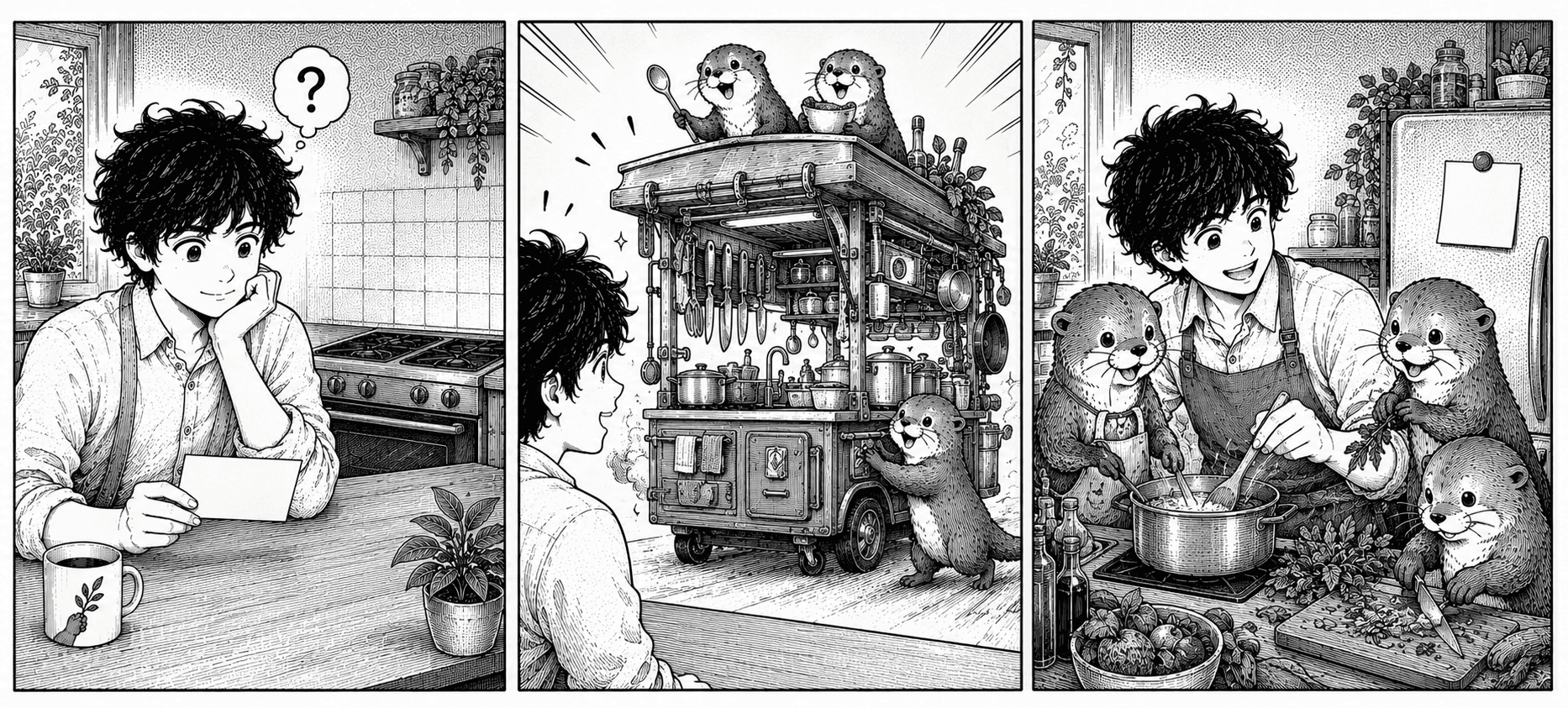
Since Skills shipped, the question I keep getting is some flavor of "isn't that the same thing as OpenOtters?"
Short answer: no, but I get why people ask. Long answer below.
What a Skill is
A Skill is a folder. You put a SKILL.md in it, plus whatever reference files
make sense, and Claude reads it at the start of a conversation. Now Claude
knows your invoice format, your incident playbook, the way your team labels
PRs, whatever you wrote down.
It's a good shape for a narrow problem. Drop in a markdown file, point Claude at it, you're done by lunch. No daemon, no registry, no container packaging.
The constraint is part of the shape though. A Skill is Claude's understanding of your procedure, running inside whichever client you happen to be in. It runs when you're chatting. It doesn't run on a server you own. There's no lifecycle to speak of. It can't kick off a job and come back to it later.
That's not a complaint, it's just what the thing is.
What an Otter is
An OpenOtters agent is a thing you deploy. You write an Agentfile, you build
it into an OCI image, you push it to a registry, you run it. Each tool the
agent uses is a separately-built BIN image. Same packaging story as Docker.
FROM scratch
RUNTIME ghcr.io/openotters/runtime:latest
MODEL anthropic/claude-haiku-4-5-20251001
NAME triage

CONTEXT SOUL <<EOF
You triage incoming GitHub issues for repo X. For each issue
you look at, you add a triage label, suggest a milestone, and
post one comment summarising what you saw. You don't close
issues without an explicit ask. You don't tag people.
EOF

BIN gh ghcr.io/openotters/tools/gh:latest "GitHub CLI"
BIN jq ghcr.io/openotters/tools/jq:latest "JSON filter"
BIN sh ghcr.io/openotters/tools/sh:latest "Compose pipelines"
That's the whole declaration. otters image build, push it somewhere, and now
you've got a portable agent. Runs under a daemon on your laptop, on a CI
runner, on a server. It has a chat surface (terminal and browser), persistent
sessions, async jobs that keep going while you walk away. The gh you see
above isn't a description of what gh does, it's a real static gh binary,
mounted into the agent's sandbox, with a content-addressed digest you can
audit.
Different layers, basically
Honest framing: they sit at different layers of the same idea.
Skills are knowledge you layer into a chat that someone else operates. You're using Anthropic's inference, Anthropic's tool harness, Anthropic's session model. What you bring to the table is the procedure.
OpenOtters is a runtime you operate yourself. You pick the model, the tool set, the persistence story, the auth surface, the lifecycle. The procedure is one piece of that, not the whole thing.
If your problem starts and ends with "Claude needs to know how we do X here", Skills are the shorter path and you should take it. Genuinely. Use the easier tool.
If your problem looks more like "I need something running unattended on a box I control, doing real work against real systems, that I can ship around like any other artifact"... that's where Otters lives.
They play nice together
There's no rule against using both, by the way. A Skill can describe how to
talk to one of your OpenOtters agents. A BIN tool from OpenOtters can show up
in a Skill's reference set as "this is what gh does in our pipeline." Same
problem space, two layers, the boundary holds.
If you were picking one because you thought the other made it redundant: it doesn't. Use whichever layer matches the problem you actually have.
brew install openotters/tap/otters if you want to poke at it. Slack
here.